Murder per Capita in Lafayette County
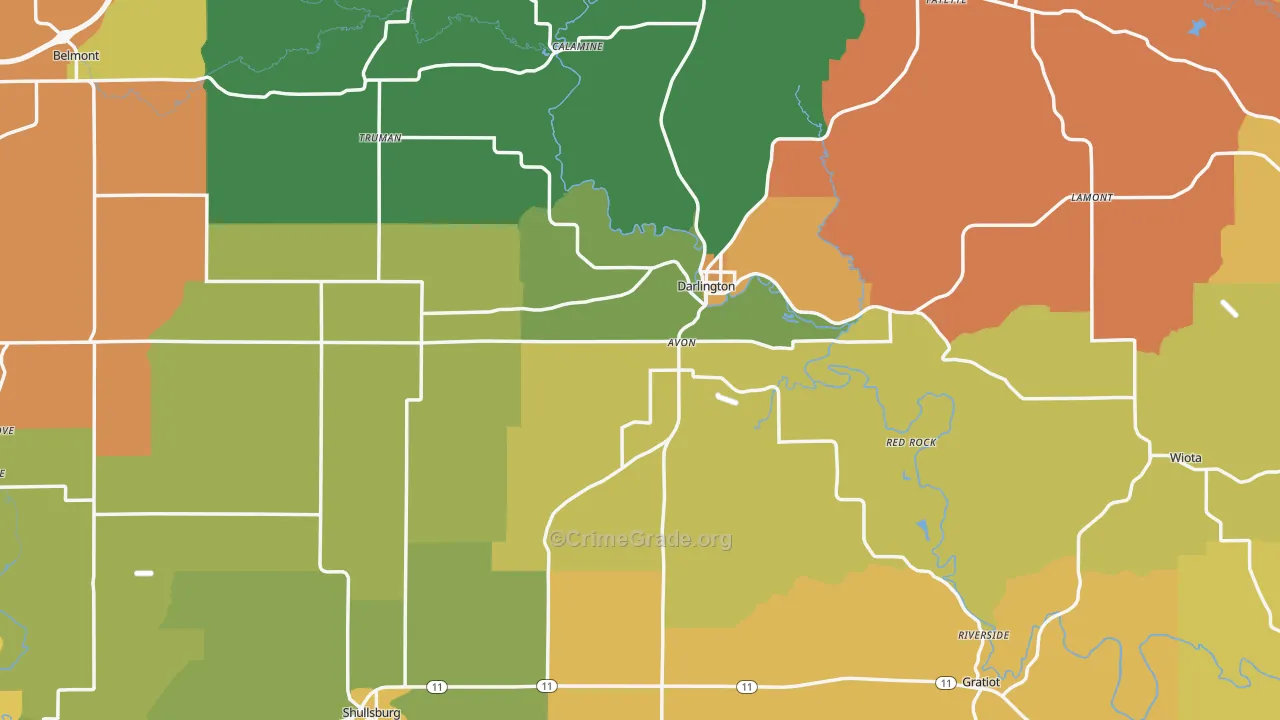
The map below shows murder per 1,000 Lafayette County residents.

The map below shows murder per 1,000 Lafayette County residents.
B
Murder Grade™
B+ |
|
B- |
|
A- |
Murder costs the average Lafayette County resident about $101 per year.
Crime Grade's murder map shows the safest places in Lafayette County in green. The most dangerous areas in Lafayette County are in red, with moderately safe areas in yellow. Crime rates on the map are weighted by the type and severity of the crime.
The B grade means the rate of murder is slightly lower than the average US county. Lafayette County is in the 66th percentile for safety, meaning 34% of counties are safer and 66% of counties are more dangerous. This analysis applies to Lafayette County's proper boundaries only. See the table on nearby places below for nearby counties.
The rate of murder in Lafayette County is 0.0537 per 1,000 residents during a standard year. People who live in Lafayette County generally consider the north part of the county to be the safest.
Your chance of being a victim of murder in Lafayette County may be as high as 1 in 14,125 in the northeast neighborhoods, or as low as 1 in 25,920 in the north part of the county.
By a simple count ignoring population, more murder occurs in the central parts of Lafayette County, WI: about 0 per year. The east part of Lafayette County has fewer cases of murder with only 0 in a typical year.
The chart below compares the murder rate in Lafayette County to the Wisconsin state average and the national average. All rates are the number of crimes per 1,000 residents in a standard year.
| Lafayette County, WI: | 0.0537 |
|---|---|
| Wisconsin: | 0.0655 |
| USA: | 0.0671 |
Considering only the murder rate, Lafayette County is safer than the Wisconsin state average and safer than the national average.
See how CrimeGrade calculates these grades and rates on the CrimeGrade methodology page.
Murder is projected to cost the residents of Lafayette County about $1,682,907 in 2025, or roughly $101 per resident. This is part of Lafayette County's overall Cost of Crime™. See the full cost-of-crime breakdown for Lafayette County, including every crime type and how Lafayette County compares to other counties.
Remember that murder rates are measured per resident. Places with heavy daytime traffic, like shopping districts, airports, and parks, can look more dangerous than they are for the people who live there. See a full guide to reading Lafayette County's crime maps on the Lafayette County overall crime page.
To better understand and navigate these intricate crime maps, a high-speed internet connection can be crucial. Fast and seamless online connectivity ensures that map details load efficiently, providing users with clearer, uninterrupted insights. If you're considering enhancing your online experience, check out high speed internet in Lafayette County, WI at ISP Reports.Compared to surrounding counties, the rate of murder in Lafayette County is similar. The table below shows Crime Grades for counties close to Lafayette County.
Nearby County | Overall Crime Grade | Violent Crime Grade | Property Crime Grade | Murder Crime Grade |
|---|---|---|---|---|
B | B- | C+ | B+ | |
A- | A | A | B- | |
A- | A- | A | B- | |
B | B+ | B | C+ | |
B | B+ | B | A+ | |
A- | B+ | A- | B+ | |
B | B | B+ | A- | |
C+ | B+ | C+ | D | |
B | A- | A- | B- | |
B- | B | B | B- |
Lafayette County is lower versus other counties of the same size for murder. The table below compares murder in counties with comparable overall population.
Similar County | Overall Crime Grade | Violent Crime Grade | Property Crime Grade | Murder Crime Grade |
|---|---|---|---|---|
D+ | D | D | F | |
B+ | C+ | C+ | B- | |
B | A | A | B | |
A | A+ | A+ | B+ | |
A+ | A+ | A+ | B+ | |
D- | D- | D- | D- | |
D | C- | C- | C | |
B- | C | C | C- | |
A- | A- | A- | B | |
A+ | A+ | A+ | B- |
Safety and school performance are separate topics, but both shape moving decisions. Using SchoolGrade data, schools in Lafayette County, WI average SchoolGrade of C+, with 39% actual proficiency versus 39% projected; overall, schools meet expectations. See Lafayette County schools on SchoolGrade
CrimeGrade.org provides highly detailed and accurate crime data, used by insurance companies, home security firms, and other industries. Our data is available for licensing—learn more about our USA crime data and licensing.
Our proprietary data is available for download by zip code or by state in a CSV Flat File. Please visit our download page for pricing and terms.
Download CSV
Your home is 300% more likely to be robbed with no home security system. Want to protect your home?
Home Security Companies in Lafayette County, WI
All maps and statistics above are projections, not certainties, and provided without guarantee free of charge. Verify all info before making any decisions based on the data.