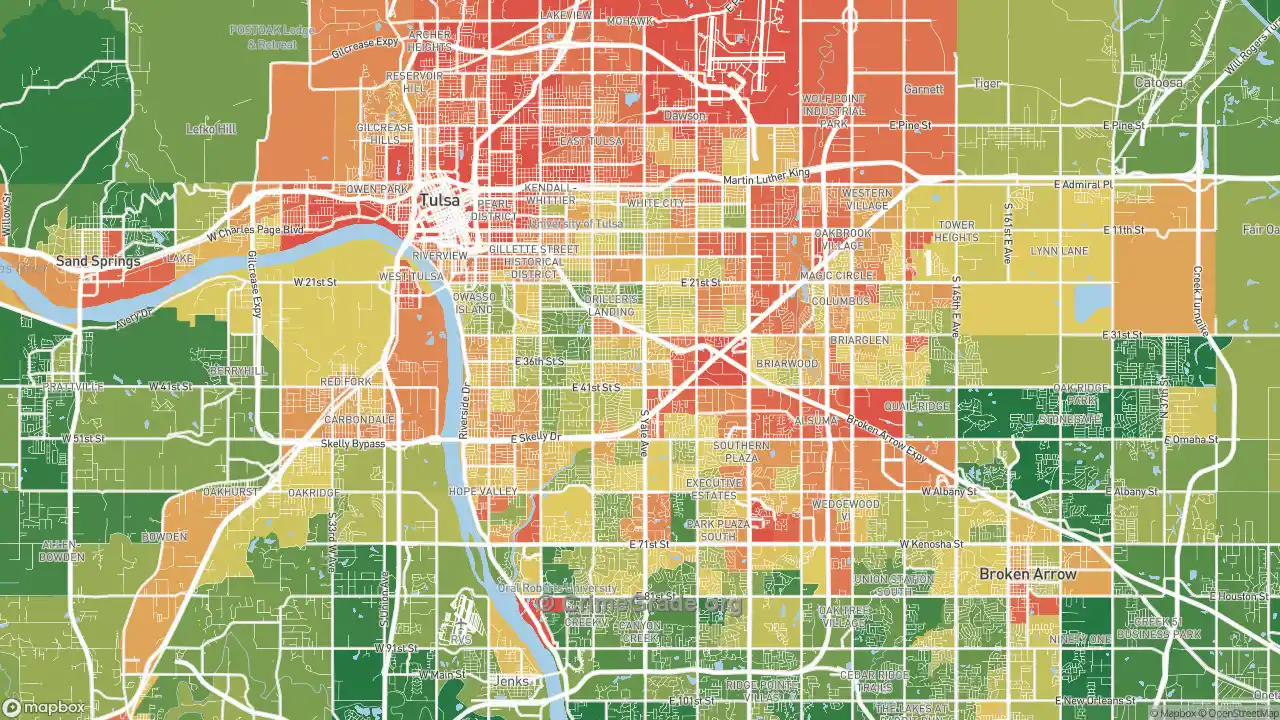
The Tulsa metro area, the 54th-largest in the US, is home to 1.04 million residents; Tulsa itself is the second-largest city in Oklahoma · Updated November 2026
How common is violent crime in the Tulsa area?
The Tulsa area earns an A- for violent crime, with more violent crime than the neighborhoods where 65% of Americans live. Assaults make up 94% of it, and most of those are simple assaults, which involve no weapon and no serious injury. The city of Tulsa itself grades C for violent crime.
A-
Violent crime CrimeGrade™
Safety score 784 of 1,000More violent crime than most US neighborhoodsi What this means
35% of Americans live in neighborhoods with more violent crime than the Tulsa area as a whole, and 65% in neighborhoods with less. The typical US neighborhood has a violent crime safety score of 860, a CrimeGrade™ of A. The Tulsa area scores 784.
Crime is concentrated in a small share of places, so most neighborhoods score high on the 0 to 1,000 scale. That is why a score in the 800s can still mean more violent crime than most US neighborhoods.
How to read the map: each area's color compares its violent crime with the people who spend time there, on one national scale, from green for the least to red for the most. Each area gets its own color, so a busy downtown or nightlife strip can show red while the homes around it stay green. The interactive maps load faster on a solid connection. Compare high speed internet in Tulsa, OK at ISP Reports.
Who this page is for: homeowners and renters in the Tulsa area, and anyone thinking about buying or renting a home there.
Business and enterprise customers: this free map shows neighborhood areas. CrimeGrade™ business reports map crime at about 66-meter detail and estimate it for one address and type of business. See business reports
What stands out about violent crime in the Tulsa area
Robberies run high in Springdale, Sequoyah & Turner Park. In this part of north Tulsa, they run at about triple the rate in the rest of Tulsa.
Where violent crime is lowest and highest in the Tulsa area
Most of the Tulsa area grades well for violent crime: 78% of residents live in areas graded A or B, and 13% in areas graded D or F. Violent crime grades across the Tulsa area run from A+ to F.
78%13%
A or B 78%C 9%D or F 13%
Share of residents, by the violent crime CrimeGrade™ of the area they live in.
Neighborhoods of Tulsa
1Kensington, Heller Park & Oral Roberts University Heights, southRobberies run at about half the rate in the rest of Tulsa.B+700
2Minshall Park, Towne Centre & Lynn Lane, southeastRobberies run at about half the rate in the rest of Tulsa.B686
3Mayo Meadow, University of Tulsa & Forest Hills, centralRobberies run about 40% lower here than in the rest of Tulsa.B623
4South Peoria, Brookside & Tulsa Hills, southwestClose to the rest of Tulsa on most crimes.C+483
5McKinley Mitchell, McClure Park & Maxwell, northeastClose to the rest of Tulsa on most crimes.C+470
6Riverview Park, Downtown Tulsa & Charles Page, westRobberies run about 30% lower here than in the rest of Tulsa.C461
7Cooper, Columbus & Longview Lake Estates, eastRobberies run about 80% higher here than in the rest of Tulsa.C-357
8Springdale, Sequoyah & Turner Park, northAggravated assaults run about 70% higher here than in the rest of Tulsa.F0
9Gilcrease Hills, Suburban Acres & Lacy Park, northwestRobberies run at about double the rate in the rest of Tulsa.F0
Neighborhood areas of the city of Tulsa, ranked by violent crime CrimeGrade™; beside each grade is its safety score, from 0 to 1,000 (higher is safer). Each one combines several of the smaller areas on the map.
Cities and towns in the Tulsa metro area with at least 1,000 residents. Ranked by violent crime CrimeGrade™; beside each grade is its safety score, from 0 to 1,000 (higher is safer), and the other numbers are residents.
Is violent crime going up in the Tulsa area?
Reported violent crime in the Tulsa area peaked in 2020 and has fallen 19% since, back near its 2019 level. Murders, rapes, robberies and aggravated assaults went from about 5.4 to 4.9 a year per 1,000 residents (US: 3.7). Violent crime changed little from 2023 to 2024.
Violent crime, change since 2019
Tulsa areaUnited States
Source: crime reports to the FBI from the police departments across the Tulsa area. The charts follow crimes per resident.
Data table
Year
Violent, Tulsa area
Violent, US
2016
+10%
+4%
2017
+6%
+4%
2018
+7%
+0%
2019
+0%
+0%
2020
+12%
+4%
2021
+7%
+6%
2022
-7%
+5%
2023
-9%
+2%
2024
-9%
-4%
Violent crime rates and types in the Tulsa area
CrimeGrade™ estimates the Tulsa area has about 20 reported violent crimes a year for every 1,000 residents, 46% more than the US as a whole and 15% more than Oklahoma.
All violent crime
Assaults
Robbery
Reported crimes a year, per 1,000 residents. Violent crime here includes simple assaults, which the FBI's violent crime rate leaves out.
Assault is the most common violent crime in the Tulsa area, about 94% of the total.
Each CrimeGrade™ here compares a violent crime with the people who spend time in an area, not only the people who live there. Rates count crimes per 1,000 residents.
Select a crime's name to see its map above. CrimeGrade™ business reports map each crime at about 66-meter detail.
Where and when violent crime happens in the Tulsa area
These figures come from the reports of the police departments across the Tulsa area, 2022 to 2024.
In the Tulsa area, 65% of aggravated assaults happen at a home, against 53% nationally. Robberies happen most often at stores and businesses: 30% of them.
Crime
Most often at
Busiest time
Robbery
Stores and businesses (30%)
Evening (6 pm to midnight)
Aggravated assault
Homes (65%)
Evening (6 pm to midnight)
Shares of the crimes reported to police, 2022 to 2024. Reports with no time recorded are left out of the times.
Violent crime in the Tulsa area and nearby metro areas
The Tulsa area has less violent crime than 7 of its 10 nearest metro areas.
Nearest first, with each place's distance from the Tulsa area. Beside each violent crime CrimeGrade™ is its safety score, from 0 to 1,000 (higher is safer).
Compared with metro areas of similar size and density, the Tulsa area is safer than 57% of them.
Among the traits that tend to go with violent crime, one sets the Tulsa area apart: it has 8% of its residents in dense blocks, against 24% nationally. Places like that tend to report less robbery, yet robbery runs higher here than that would suggest.
Residents in dense blocksBlocks of 10,000 or more people per square mile. Dense neighborhoods tend to report more robbery.8% of residentsUS: 24%Lower than for 85% of Americans in metro areas
Transit serviceBuses and trains an hour at the evening rush. Places with busy transit tend to report more robbery. BestNeighborhood's Transit Grade for the Tulsa area: D- (7 of 100).2 trips an hourUS: noneLower than for 75% of Americans in metro areas
These traits tend to go with more or less crime; none of them causes it on its own. Sources: Census job counts and housing figures, OpenStreetMap and Overture business listings, CrimeGrade™ parking estimates, NASA night-light imagery, US Forest Service tree cover, EPA transit data and BestNeighborhood's Walk Grade.
What violent crime costs the Tulsa area
Counting the pain and suffering of victims, violent crime costs the Tulsa area about $1.74 billion a year, or $1,679 per resident. The costs that reach a bill, such as medical care, lost work and the justice system, come to about $385 million, or $371 per resident.
Billed cost of violent crime per resident, per year
How the cost breaks down
Pain and suffering are about 78% of that full cost.
Crime
Cost a year
Per resident
Murder
$105 million
$101
Rape
$40 million
$38
Robbery
$15 million
$14
Assault
$226 million
$217
Total
$385 million
$371
How CrimeGrade™ works
The violent crime CrimeGrade™ covers murder, rape, robbery and assault, from A+ for the least crime to F for the most, on one scale for the whole country.
It weighs each violent crime against the people who spend time in an area, so a busy downtown is graded on its workers and visitors as well as its residents.
The rates on this page count crimes for every 1,000 people who live here, the way police departments report them. The Tulsa area is a good example: many people work in, shop in or visit it, so its crime per resident looks worse than its CrimeGrade™ suggests.
Comparisons with US neighborhoods use the Census Bureau's block groups, small areas of about 1,400 residents, and count the people who live in each. These figures cover the whole Tulsa metro area. The figures count crimes reported to police; many crimes, shoplifting above all, never are. Behind the grades, CrimeGrade™ tested 21,607 factors from 125 data families. For business owners, paid CrimeGrade™ location reports estimate crime at a single address for each type of business.
Where the numbers come from
Crime reports that police departments file with the FBI
State crime records and city crime data, where they are published
Published research on what crime costs victims and communities
These are estimates of reported crime for whole areas, not a record of what happened on any one street. CrimeGrade™ updates them once a year and provides them free and without guarantee. Check local sources before you rely on them for a decision.