
The Best Home Security Systems in Hawaii
Are you looking for the best home security systems in Hawaii? Using Crime Grade’s exceptional crime data that is accurate down to the neighborhood, we have analyzed Hawaii home security system options in a way no other source has been able to do. See why
A property crime is committed in Hawaii every 9 minutes, and nationwide, your home is 300% more likely to be burglarized without a home security system. Hawaii experiences 37.72 property crimes per 1000 people and 12.25 incidents of vandalism per 1000 people in the typical year. A home security system will protect you when you’re at home or away, 24 hours a day.
Home Security Companies Available in Hawaii
Best Overall
ADT
We believe ADT is the best home security system for residents of Hawaii. A higher median income of $93,305 along with an aging population (the median age in Hawaii is 41) solidifies ADT as our recommendation.
No Contract Pick
Simplisafe
These guys offer the best all-round balance of equipment, monitoring, customer service, and price. They’re reliable and the keep your home safe—it’s a fairly comfortable #1 spot.
Affordable Option
Ring
Ring Alarm is a disrupter whose incredibly low monitoring fees (as low as 1/10th the price of larger and better-known companies) and sharp equipment has already made them a household name.
Do You Need a Home Security System in Hawaii?
Choosing a home security system can seem overwhelming. We’re here to help break down what to consider when living in Hawaii. We’ll compare different crime rates and weather along with advanced features that make you feel safer and make your life easier.
Why Crime Grade?
Crime Grade has the most robust and accurate nationwide crime model available. In addition, our data is granular enough to identify and compare crime statistics to the neighborhood level. This puts us in the unique position of being able to evaluate the home security needs of people in a particular state rather than making a general assessment. So read on to see what’s unique about Hawaii and our home security system recommendations that result from that.
Property Crime in Hawaii
Our analysis gives Hawaii a property crime grade of: D. Hawaii is in the 80th percentile of safety, meaning 80% of cities in the United States are safer and 20% are more dangerous. Please visit our Hawaii crime map for details on how this is calculated and what it means.
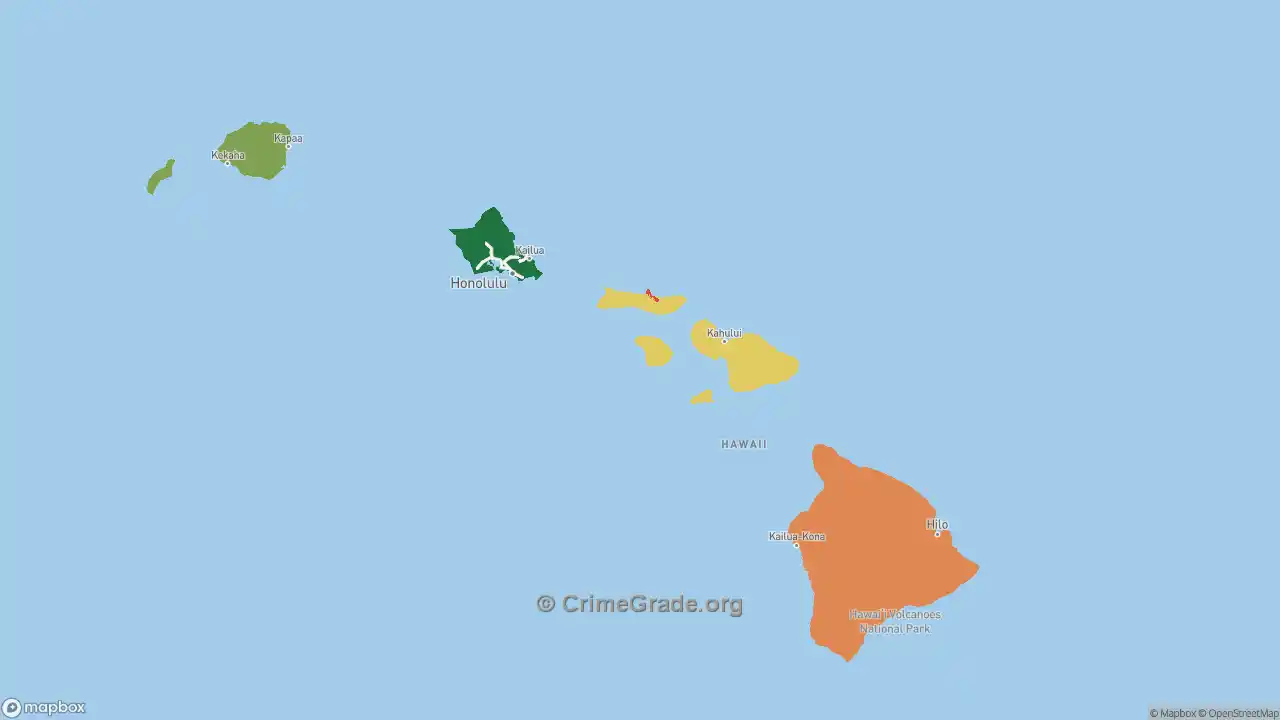
Property crime is highest in the southeastern part of Hawaii, with your chances of being a victim of 1 in 8. Compare this to the northern part of the state, where crime is lower, and your chances of being a victim are 1 in 93.
D+
C- |
|
D |
|
Other Crime Grade |
C- |
A crime occurs every 5 minutes (on average) in Hawaii.
Your home is 300% more likely to be robbed with no home security system.
So, is Hawaii safe? Compared to all of the United States, Hawaii is rated as safe as the average the United States state, which has a property crime rate of 27.99 per 1000. Looking at burglary, we see a different pattern, where Hawaii, with its burglary rate of 6.479 per 1000, is as safe as the average the United States state.
In addition, Hawaii is higher than other states with similar populations for property crime. The table below shows property crime rates and level of occurrence in Hawaii.
Crime Type |
Crime Rate (per 1000 residents) |
Avg Number of Crimes per year in Hawaii |
Avg Crimes Committed Per Week |
|---|---|---|---|
Theft |
26.48 |
40,025 |
769.7 |
Vehicle Theft |
4.509 |
6,816 |
131.1 |
Burglary |
6.479 |
9,793 |
188.3 |
Arson |
0.2553 |
386 |
7.4 |
Weather and Climate in Hawaii
As strange as it might sound, some home security system features can be more or less important based on the climate you live in.
Home Security Fire Sensors in Hawaii
Hotter temperatures can lead to higher risk of fires in the home. The average temperature in Hawaii is 75.21 degrees, reaching 89.31 degrees in the hottest months like August & September. This temperature has held steady compared to 1990, when the hottest month reached 90.37 degrees in August.
Home age is another factor in determining fire risk, primarily due to electrical issues. The average home in Hawaii was built in 1980, which is about average compared to the national average of 1978 and is much older than the average home in the United States build in 1978.
Between average seasonal temperatures and average home ages in Hawaii, you can judge how important fire sensors and immediate response may be. A combination of smoke detectors, CO2 sensors, and fire alarms connected to a home security system can make that response as swift as possible, whether you’re at work or on vacation.
Home Security Flood Sensors in Hawaii
Hawaii gets an average rainfall of 0.4" per year. This is lower than the average of 30.2" for the United States.
With the risk of flooding and burst pipes, a flood sensor can alert you and authorities as soon as possible. Even a few hours make the difference between an easy restoration and long-term water damage.
Home Security Freeze Sensors in Hawaii
The year a home was constructed can also contribute to the risk of damage from cold weather. The average home in Hawaii is 43 years old, and seasonal temperature changes have had much more time to cause stress on the home compared to the average the United States home that’s 45 years old and about the same amount of time than the national average of a 45-year-old home.
Temperature fluctuations will weaken the structure and foundation of the home, cold temperatures can cause pipes to leak or burst, and if it snows that can cause additional stress on the roof. However, freeze sensors are not an expensive addon. After assessing your Hawaii home, you can make a more informed decision if they would be a suitable addition to your home security system.
Cost of Home Security Systems in Hawaii
To identify the final cost of a home security system for your Hawaii home, we must determine some of your preferences.
Self-Monitored or Professionally Monitored?
Any home security system you pick will offer a selection of equipment including entry sensors, cameras, etc. The question is, do you actually want to self-monitor your system? If like 36.87% (536,545) of people in Hawaii, you are a renter, you might prefer a self-monitored home security system. On the other hand, 63.13% or 918,726 of Hawaii residents own their homes and may be more likely to consider a professionally monitored system to protect their property.
Whether you rent or buy, how well can you monitor your system on your own? For example, if you’re one of the 79% of people who commute an average of 34 minutes to work in or around Hawaii, can you immediately receive notifications on your phone, check cameras in meetings or while working, and call the police if needed?
If not, you might want a professionally monitored system where a company is available 24/7 to respond, whether on vacation or at work. Please see our comprehensive guide on the best home security systems for a complete comparison.
Self-Installed vs. Professional Installation
Most providers have great self-installation options, so if you’re handy or tech-savvy, like the 5% of Hawaii residents working in computer engineering and science, self-installation can be a great option.
Alternatively, when your security system is installed professionally, you can ensure that your equipment is placed correctly and will function without any problems. That peace of mind is valuable for people willing to spend the extra money.
Residents of Hawaii tend to have a higher median household income than nearby states, earning $93,305 annually. In addition, 33.0% of residents have a college degree or higher, compared to 32.9% in the United States.
If you’re a homeowner, do you have more to protect? The median home value in Hawaii is $682,000. Compared to the median home value in the United States of $318,880, your home value will probably be higher. With their larger lots, single-family homes tend to be more isolated from view and a tempting target for burglars.
Find an in-depth review of installation options in our best home security systems guide.
Police Stations Near Hawaii
There are 354 police stations within the boundaries of Hawaii, and 0 within 5 miles. Within 50 miles of the Hawaii center, there are 36 police stations. Compared to other states, police response times in Hawaii may be slower. When response times can be improved, every second your security system saves in reporting a crime will improve the police response.
| Maui County Police Dept-Lanai 855 Fraser Avenue Lanai City, HI 96763 (808) 565-6428 molokai-lanai-maui-hawaii.com |
County Of Maui 375 Mauna Loa Highway Kaunakakai, HI 96748 (808) 553-5355 maui.net |
Lahaina Police Department 1850 Honoapiilani Highway Lahaina, HI 96761 (808) 661-4441 npd.net |
Safest Cities in Hawaii
According to our analysis, here are the safest cities in Hawaii.Home Security and Property Crime in States Near Hawaii
Nearby State | Property Crime Grade | Overall Crime Grade | Safer than Hawaii? |
|---|---|---|---|
| California | D | D- | about as safe |
| Oregon | D- | D+ | less safe |
| Nevada | D- | D | less safe |
| Washington | D+ | D- | more safe |
| Idaho | A | A+ | more safe |
| Arizona | F | F | less safe |
| Utah | C- | C- | more safe |
| Montana | C+ | B- | more safe |
| New Mexico | D+ | D | about as safe |
| Wyoming | B+ | B- | more safe |
Home Security and Property Crime in States Similar to Hawaii
Nearby State | Property Crime Grade | Overall Crime Grade | Safer than Hawaii? |
|---|---|---|---|
| Arkansas | C | C | more safe |
| California | D | D- | about as safe |
| Florida | B- | C | more safe |
| Georgia | C | C+ | more safe |
| Alaska | D | F | about as safe |
| North Carolina | D+ | C- | about as safe |
| South Carolina | D- | F | about as safe |
| North Dakota | C- | C+ | more safe |
| Ohio | B- | A- | more safe |
| Oklahoma | F | D | less safe |
Summarizing Home Security Considerations in Hawaii
Deciding whether you need a home security system in Hawaii can be a complicated decision. We've used distrinctive property crime statistics and varying environment factors about the state to help us make an objective recommendation for most residents. Leveraging CrimeGrade.org's uniquely robust and granular crime data, we've scrutinized the options for home security systems, tailoring them to the unique needs and context of Hawaii residents.
Combining the property crime Grades, demographic information, and local climate conditions for advanced home security features gives us some companies that stand out.
ADT, Simplisafe, and Ring have emerged as the top choices for Hawaii residents due to their distinctive offerings and reliability, each appealing to varied preferences and budget ranges of homeowners and renters alike. Notably, factors such as Hawaii's climate, housing age, and average income levels further steer the home security considerations.
Property Crime Insights
- A property crime occurs approximately every 9 minutes in Hawaii.
- The state experiences 37.72 property crimes and 12.25 vandalism insidents per 1,000 people annually.
- Hawaii's property crime grade stands at an 'D', comparably as safe as other the United States {{place_type__plural_lower}}.
Noteworthy Security Companies
- ADT: We believe ADT is the best home security system for residents of Hawaii. A higher median income of $93,305 along with an aging population (the median age in Hawaii is 41) solidifies ADT as our recommendation.
- Simplisafe: These guys offer the best all-round balance of equipment, monitoring, customer service, and price. They’re reliable and the keep your home safe—it’s a fairly comfortable #1 spot.
- Ring: Ring Alarm is a disrupter whose incredibly low monitoring fees (as low as 1/10th the price of larger and better-known companies) and sharp equipment has already made them a household name.
Climate Considerations for Security
- Fire sensors could be worth considering, since the average temperature reaches 89.31 degrees in the peak months of August & September.
- Flood sensors are also worth considering due to the 0.4" of average yearly rainfall and house age of 43 years.
Self vs. Professional Monitoring & Installation
- 36.87% of Hawaii residents are renters, potentially inclining towards self-monitored systems.
- Given the 79% of commuters, professional monitoring might offer valuable peace of mind.
- Considering Hawaii's higher household median income of $93,305 and 33.0% college-degree holding populace, investment in professional installation and advanced system features might be favorable.
Local Police Presence
- Hawaii hosts 354 police stations within it's borders, potentially influencing response times.