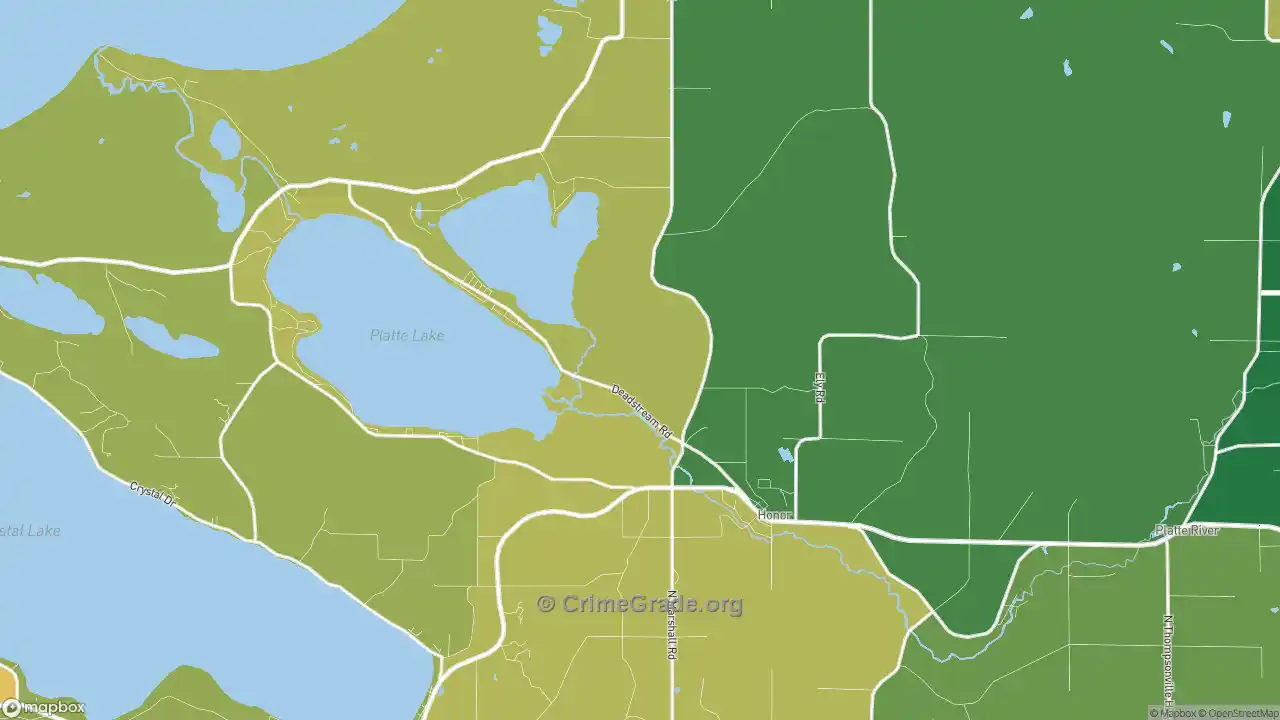
Honor is a village of 1,440 in Benzie County, about 25 miles west of downtown Traverse City · Updated November 2026
How common is property crime in Honor?
Property crime is low in Honor: an A+, safer than the neighborhoods where 95% of Americans live. Theft makes up 47% of it. Burglary, the crime most likely to reach into a home, grades A+, and vehicle theft grades A+.
A+
Property crime CrimeGrade™
Safety score 975 of 1,000Less property crime than nearly all US neighborhoodsi What this means
95% of Americans live in neighborhoods with more property crime than Honor as a whole, and 5% in neighborhoods with less. The typical US neighborhood has a property crime safety score of 823, a CrimeGrade™ of A-. Honor scores 975.
Crime is concentrated in a small share of places, so most neighborhoods score high on the 0 to 1,000 scale. That is why a score in the 800s can still mean more property crime than most US neighborhoods.
How to read the map: each area's color compares its property crime with the homes, parked cars and people there, on one national scale, from green for the least to red for the most. Each area gets its own color, so a busy shopping center can show red while the homes beside it stay green. The interactive maps load faster on a strong connection. Compare high speed internet in Honor, MI at ISP Reports.
Who this page is for: homeowners and renters in Honor, and anyone thinking about buying or renting a home there.
Business and enterprise customers: this free map shows neighborhood areas. CrimeGrade™ business reports map crime at about 66-meter detail and estimate it for one address and type of business. See business reports
Property crime rates and types in Honor
CrimeGrade™ estimates Honor has about 9.7 reported property crimes a year for every 1,000 residents, 59% less than the US as a whole and 49% less than Michigan.
All property crime
Burglary
Vehicle theft
Reported crimes a year, per 1,000 residents. Property crime here includes vandalism, which the FBI's property crime rate leaves out.
Theft is the most common property crime in Honor, about 47% of the total, followed by vandalism and burglary.
Each CrimeGrade™ here compares a property crime with what it affects: homes for burglary and arson, parked cars for vehicle theft, people and parking for theft, homes and businesses for vandalism. Rates count crimes per 1,000 residents.
Select a crime's name to see its map above. CrimeGrade™ business reports map each crime at about 66-meter detail.
Where and when property crime happens in Honor
The Benzie County Sheriff's Office polices Honor, and these figures cover every place it serves, 2022 to 2024.
Crime
Most often at
Busiest time
Vandalism
Homes (51%)
Evening (6 pm to midnight)
Shares of the crimes reported to police, 2022 to 2024. Reports with no time recorded are left out of the times.
Property crime in Honor and nearby cities
Of the 6 cities closest to Honor, 5 have less property crime. Empire and Lake Ann have the least.
Property crime costs Honor about $95,000 a year, or $66 per resident and about $140 per household: the value of what is stolen or damaged, plus the police, courts and prisons that respond.
Cost of property crime per resident, per year
How the cost breaks down
Pain and suffering add little to the cost of property crime, so this is close to its full cost.
Crime
Cost a year
Per resident
Burglary
$10,000
$7
Theft
$33,000
$23
Vehicle theft
$6,900
$5
Arson
$5,200
$4
Vandalism
$40,000
$28
Total
$95,000
$66
How CrimeGrade™ works
The property crime CrimeGrade™ covers burglary, theft, car theft, arson and vandalism, from A+ for the least crime to F for the most, on one scale for the whole country.
It weighs each property crime against what it affects: homes for burglary and arson, parked cars for car theft, and the people and parking around stores for theft.
The rates on this page count crimes for every 1,000 people who live here, the way police departments report them. Honor is a good example: many people work in, shop in or visit it, so its crime per resident looks worse than its CrimeGrade™ suggests.
Comparisons with US neighborhoods use the Census Bureau's block groups, small areas of about 1,400 residents, and count the people who live in each. The figures count crimes reported to police; many crimes, shoplifting above all, never are. Behind the grades, CrimeGrade™ tested 21,607 factors from 125 data families. For business owners, paid CrimeGrade™ location reports estimate crime at a single address for each type of business.
Where the numbers come from
Crime reports that police departments file with the FBI
State crime records and city crime data, where they are published
Published research on what crime costs victims and communities
These are estimates of reported crime for whole areas, not a record of what happened on any one street. CrimeGrade™ updates them once a year and provides them free and without guarantee. Check local sources before you rely on them for a decision.