Property Crime per Capita in Indian Hills
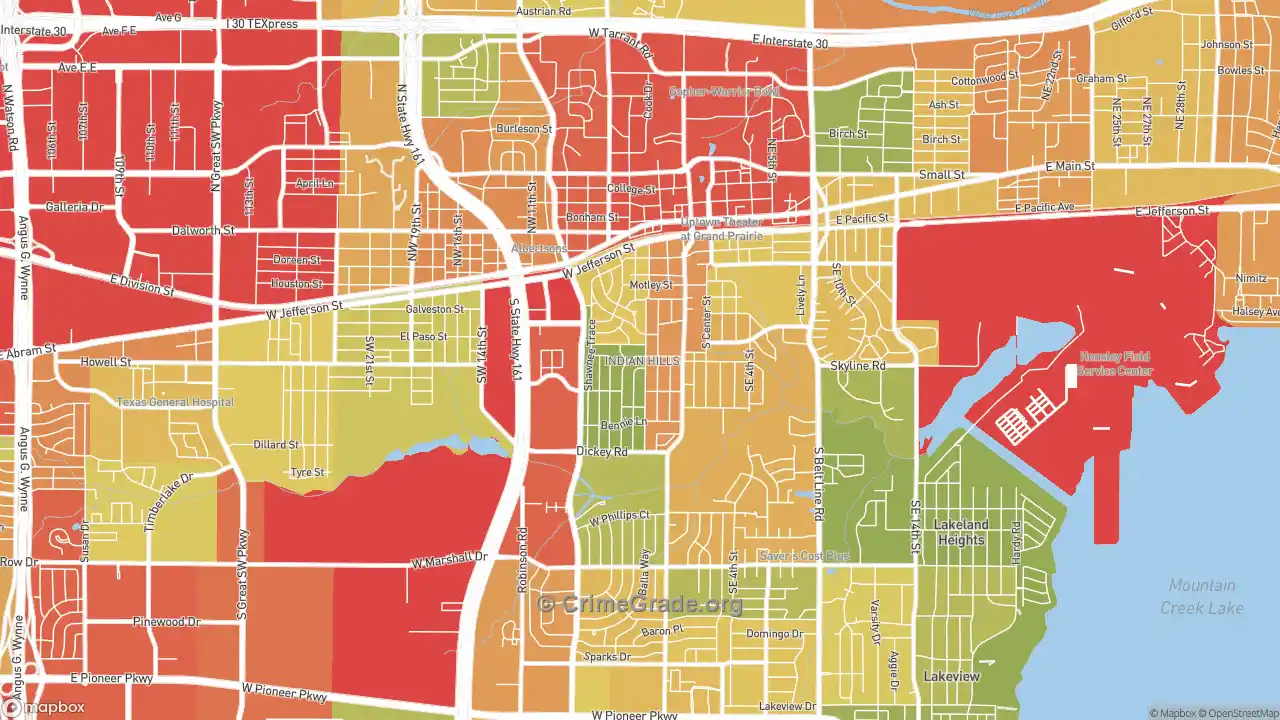
Property crime covers theft, burglary, vehicle theft, and arson, offenses against belongings rather than people. The map below shows the property crime rate per 1,000 Indian Hills residents.

Property crime covers theft, burglary, vehicle theft, and arson, offenses against belongings rather than people. The map below shows the property crime rate per 1,000 Indian Hills residents.
$962,659
In 2025, property crime will cost $551 per household.
On the map, green marks the parts of Indian Hills with the least property crime and red marks the most, weighted by the type and severity of each offense. Property crime is the most common category of crime, so these maps track closely with where stores, parking, and daytime foot traffic sit. The Interpreting the Crime Maps section below explains why busy commercial blocks can look worse than the neighborhoods around them.
The B- grade reflects how often theft, burglary, vehicle theft, and arson happen in Indian Hills against the average US neighborhood, where the rate is slightly lower than the norm. Indian Hills sits in the 61st percentile for property-crime safety, ahead of 61% of neighborhoods and behind 39%. The grade covers only Indian Hills’s official city boundaries. See the table below for nearby neighborhoods.
The property crime rate in Indian Hills is 19.12 per 1,000 residents in a typical year. Residents generally point to the south part of the neighborhood as the safest for their belongings. Your odds of a property-crime loss range from 1 in 35 in the southwest areas to 1 in 89 in the south.
Counting total incidents instead of per-capita rates, the southwest parts of Indian Hills, Grand Prairie, TX report the most property crime, about 29 cases per year. The northwest part reports the fewest, around 1 per year.
Property crime in Indian Hills is projected to cost $962,659 in 2025, about $187 per resident and $551 per household. That equals 0.9% of the median household income. All of it is measurable loss: replaced vehicles, repaired break-ins, stolen goods, and the policing and courts that respond.
Because property crime leaves a repair bill rather than a lasting injury, these tangible costs make up its full economic toll. They split into:
| Indian Hills, Grand Prairie, TX: | $187 |
|---|---|
| Far North Dallas-Richardson, R: | $906 |
| Far North Dallas-Justin, Justi: | $50 |
| Texas: | $164 |
| USA: | $136 |
Property crime costs $187 per resident each year in Indian Hills, which is $51 more than the national average and $23 more than Grand Prairie’s city average. The comparison below uses neighborhoods similar to Indian Hills:
The table below breaks the property-crime total into its four offenses for Indian Hills, with the projected cost per resident.
Crime |
Cost to Indian Hills |
Cost per Indian Hills Resident |
|---|---|---|
Vehicle Theft |
$603,758 |
$118 |
Burglary |
$101,287 |
$20 |
Theft |
$246,200 |
$48 |
Arson |
$11,414 |
$2 |
Total Cost of Property Crime |
$962,659 |
$187 |
Property crime carries no pain-and-suffering figure in this model. Its cost is the replacement and repair value of what was taken or damaged, plus the policing, courts, and lost offender productivity that follow. Stolen and damaged property has a market price, which is why this total is easier to pin down than the human cost of violent crime in Indian Hills, Grand Prairie, TX.
All Cost of Crime figures come from scholarly research on the cost of crime. Read more about our methodology here.
Property crime rates are measured per resident, so places where shoppers and commuters outnumber residents read high. Stores are where shoplifting, theft, and vehicle break-ins happen, yet almost nobody lives there, so the per-capita rate climbs. How strongly this shows on the map depends on retail density; the west part of the neighborhood has more retail establishments. A red commercial strip does not mean the homes nearby are unsafe.
Parking lots and transit stops follow the same pattern: heavy daytime traffic, few residents, so per-capita property crime reads high. To judge a residential block, weigh both the per-capita rate and the total number of incidents, and note what sits nearby.
The interactive maps load faster on a strong connection. Compare high speed internet in Indian Hills, Grand Prairie, TX at ISP Reports.
The table below shows which non-violent crimes are used to calculate the Crime Grade above. All property crime rates are shown as the number of crimes per 1,000 Indian Hills residents in a standard year.
Crime Type |
Crime Rate |
|---|---|
Theft |
9.258 |
Vehicle Theft |
7.593 |
Burglary |
2.175 |
Arson |
0.0920 |
Total Property Crime |
19.12 (B-) |
Compared to surrounding neighborhoods, the rate of property crime in Indian Hills is lower. The table below shows Crime Grades for neighborhoods close to Indian Hills.
Nearby Neighborhood | Overall Crime Grade | Violent Crime Grade | Property Crime Grade |
|---|---|---|---|
C- | C- | D+ | |
B- | C | B+ | |
C | C | C | |
D | D | D- | |
D+ | D | D | |
B | B- | B+ | |
B+ | B- | B+ | |
B- | B- | B- | |
B- | C | B | |
B- | C+ | B+ |
Indian Hills is lower versus other neighborhoods of the same size for property crime. The table below compares crime in neighborhoods with comparable overall population in the neighborhood‘s boundaries.
Similar Neighborhood | Overall Crime Grade | Violent Crime Grade | Property Crime Grade |
|---|---|---|---|
A | A | A | |
C- | B | B | |
B+ | A- | A- | |
A+ | A+ | A+ | |
F | F | F | |
C | C+ | C+ | |
D+ | D+ | D+ | |
B- | A+ | A+ | |
B | A- | A- | |
D- | D | D |
Considering only the property crime rate, Indian Hills is safer than the Texas state average and as safe as the national average.
CrimeGrade.org provides highly detailed and accurate crime data, used by insurance companies, home security firms, and other industries. Our data is available for licensing—learn more about our USA crime data and licensing.
Our proprietary data is available for download by zip code or by state in a CSV Flat File. Please visit our download page for pricing and terms.
Download CSV
A crime occurs on average every 2 days 5 hours in Indian Hills. Want to protect your home?
Home Security Companies in Indian Hills, Grand Prairie, TX
All maps and statistics above are projections, not certainties, and provided without guarantee free of charge. Verify all info before making any decisions based on the data.