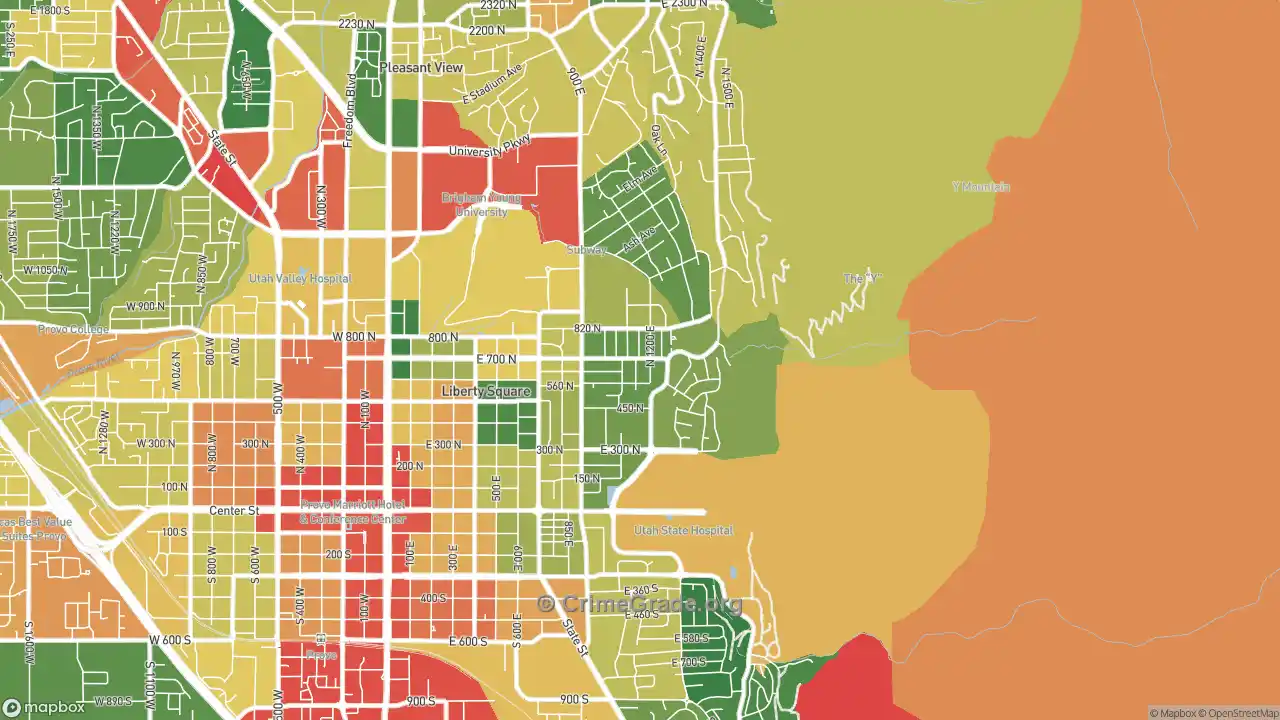
Tree Streets, Provo, UT Property Crime Rates and Maps
Tree Streets is a neighborhood of 5,900 residents in Provo, close to downtown · Updated November 2026
How common is property crime in Tree Streets?
Tree Streets earns an A- for property crime, with more property crime than the neighborhoods where 55% of Americans live. Theft makes up 55% of it. Burglary, the crime most likely to reach into a home, grades A+, and vehicle theft grades A. Provo as a whole grades A- for property crime.
A-
Property crime CrimeGrade™
Safety score 791 of 1,000About as much property crime as the typical US neighborhoodi What this means
45% of Americans live in neighborhoods with more property crime than Tree Streets as a whole, and 55% in neighborhoods with less. The typical US neighborhood has a property crime safety score of 823, a CrimeGrade™ of A-. Tree Streets scores 791.
Crime is concentrated in a small share of places, so most neighborhoods score high on the 0 to 1,000 scale. That is why a score in the 800s can still mean more property crime than most US neighborhoods.
How to read the map: each area's color compares its property crime with the homes, parked cars and people there, on one national scale, from green for the least to red for the most. Each area gets its own color, so a busy shopping center can show red while the homes beside it stay green. The interactive maps load faster on a strong connection. Compare high speed internet in Tree Streets, Provo, UT at ISP Reports.
Who this page is for: homeowners and renters in Tree Streets in Provo, and anyone thinking about buying or renting a home there.
Business and enterprise customers: this free map shows neighborhood areas. CrimeGrade™ business reports map crime at about 66-meter detail and estimate it for one address and type of business. See business reports
What stands out about property crime in Tree Streets
Thefts from cars happen at homes far more often than nationally. In Provo as a whole, 74% of reported thefts from cars happen at homes, against 34% nationally.
Theft runs low. Tree Streets has 5.9 thefts a year per 1,000 residents, less than half the US rate of 13.1.
Property crime rates and types in Tree Streets
CrimeGrade™ estimates Tree Streets has about 11 reported property crimes a year for every 1,000 residents, 55% less than the US as a whole and 41% less than Provo as a whole.
All property crime
Burglary
Vehicle theft
Reported crimes a year, per 1,000 residents. Property crime here includes vandalism, which the FBI's property crime rate leaves out.
Theft is the most common property crime in Tree Streets, about 55% of the total, followed by vandalism and burglary.
Each CrimeGrade™ here compares a property crime with what it affects: homes for burglary and arson, parked cars for vehicle theft, people and parking for theft, homes and businesses for vandalism. Rates count crimes per 1,000 residents.
Select a crime's name to see its map above. CrimeGrade™ business reports map each crime at about 66-meter detail.
Where and when property crime happens in Provo
The Provo Police Department polices Tree Streets; these figures cover Provo as a whole, 2022 to 2024.
In Provo as a whole, 62% of burglaries hit homes, against 57% nationally. Car thefts happen most often at homes: 63% of them, against 33% nationally.
Crime
Most often at
Busiest time
Burglary
Homes (62%)
Afternoon (noon to 6 pm)
Car theft
Homes (63%)
Morning (6 am to noon)
Theft from cars
Homes (74%)
Evening (6 pm to midnight)
Vandalism
Homes (48%)
Afternoon (noon to 6 pm)
Shares of the crimes reported to police, 2022 to 2024. Reports with no time recorded are left out of the times.
Property crime in Tree Streets and nearby neighborhoods
Tree Streets has less property crime than 7 of its 10 nearest neighborhoods.
Nearest first, with each place's distance from Tree Streets. Beside each property crime CrimeGrade™ is its safety score, from 0 to 1,000 (higher is safer).
Compared with neighborhoods of similar size and density, Tree Streets is safer than 91% of them.
Shops, empty homes and walkability in Tree Streets
Among the traits that tend to go with property crime, two set Tree Streets apart: it has 1.4 stores and restaurants for every 1,000 residents, against 10.5 nationally, and 2.1% of its homes standing empty, against 7.1% nationally. Places like that tend to report less theft and car theft, yet theft runs higher here than that would suggest.
Stores and restaurantsShops and restaurants draw crowds and parked cars. Places with many stores tend to report more theft and car theft.1.4 per 1,000 residentsUS: 10.5Lower than for 97% of residents of US city neighborhoods
Empty homesSeasonal and vacation homes are left out. Places with many empty homes tend to report more burglary, vandalism and arson.2.1% of homesUS: 7.1%Lower than for 94% of residents of US city neighborhoods
Walk GradeBestNeighborhood's grade for getting through daily life on foot, traced along real walking routes to shops, schools and parks. Walkable places tend to report more theft. 86% of residents here live in car-dependent areas.D+ (18 of 100)US: 21Lower than for 77% of residents of US city neighborhoods
Show all 4
JobsJobs draw daytime crowds. Places with many jobs tend to report more theft.16 for every 100 residentsUS: 45Lower than for 78% of residents of US city neighborhoods
These traits tend to go with more or less crime; none of them causes it on its own. Sources: Census job counts and housing figures, OpenStreetMap and Overture business listings, CrimeGrade™ parking estimates, NASA night-light imagery, US Forest Service tree cover, EPA transit data and BestNeighborhood's Walk Grade.
What property crime costs Tree Streets
Property crime costs Tree Streets about $410,000 a year, or $70 per resident and about $237 per household: the value of what is stolen or damaged, plus the police, courts and prisons that respond.
Cost of property crime per resident, per year
How CrimeGrade™ works
The property crime CrimeGrade™ covers burglary, theft, car theft, arson and vandalism, from A+ for the least crime to F for the most, on one scale for the whole country.
It weighs each property crime against what it affects: homes for burglary and arson, parked cars for car theft, and the people and parking around stores for theft.
The rates on this page count crimes for every 1,000 people who live here, the way police departments report them.
Comparisons with US neighborhoods use the Census Bureau's block groups, small areas of about 1,400 residents, and count the people who live in each. The figures count crimes reported to police; many crimes, shoplifting above all, never are. Behind the grades, CrimeGrade™ tested 21,607 factors from 125 data families. For business owners, paid CrimeGrade™ location reports estimate crime at a single address for each type of business.
Where the numbers come from
Crime reports that police departments file with the FBI
State crime records and city crime data, where they are published
Published research on what crime costs victims and communities
These are estimates of reported crime for whole areas, not a record of what happened on any one street. CrimeGrade™ updates them once a year and provides them free and without guarantee. Check local sources before you rely on them for a decision.