Cost of Crime™ for Twin View Heights, IA
$147,379
In 2025, crime will cost $417 per household.
More cost data
Put this on your site: embed the map, grade card or badge.
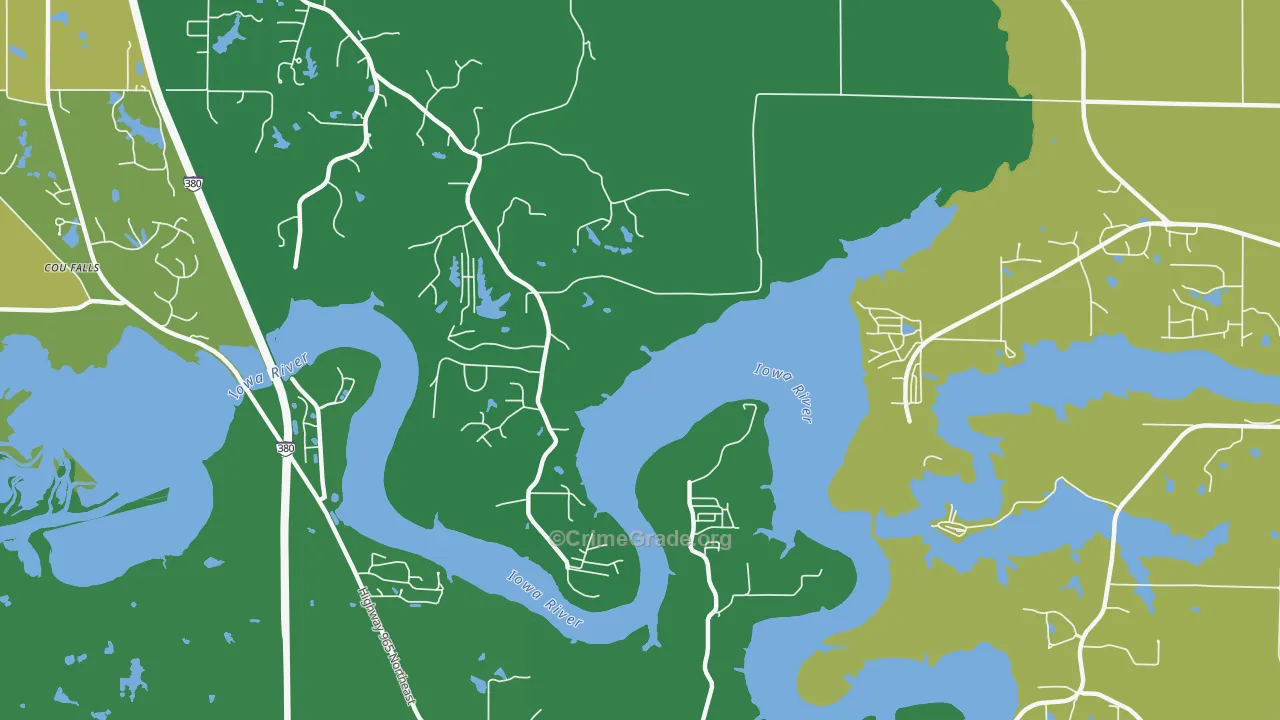
On the map, green marks the parts of Twin View Heights with the least crime overall and red marks the most. Each area is weighted by the type and severity of every offense, so a place with rare but serious violent crime can grade differently from one with frequent petty theft. The Interpreting the Crime Maps section below explains how to read the colors.
Is Twin View Heights, IA Safe?
The A+ overall grade blends the violent, property, and other grades shown above into one measure, set against the average US city, where Twin View Heights's combined rate is much lower than the norm. Twin View Heights sits in the 96th percentile, ahead of 96% of cities and behind 4%. The grade covers only Twin View Heights's official city boundaries. See the table below for nearby cities.
The overall crime rate in Twin View Heights is 10.18 per 1,000 residents in a typical year. Residents generally consider the southwest part of the city the safest. Your chance of being a victim ranges from 1 in 76 in the east neighborhoods to 1 in 103 in the southwest.
Counting total incidents instead of per-capita rates, the southwest parts of Twin View Heights, IA report the most crime, about 7 cases per year. The northeast part reports the fewest, around 0 per year.
The Cost of Crime™ in Twin View Heights, IA
Across all crime types, the projected cost of crime in Twin View Heights for 2025 is $147,379, about $156 per resident and $417 per household. That equals 0.2% of the median household income.
These figures cover tangible costs, which include:
- Criminal justice system costs (law enforcement, courts, and imprisonment): 62.0%
- Direct costs to victims (damaged property, medical expenses, and lost wages): 23.5%
- Lost economic contribution from offenders (time in prison or repeat offenses): 14.5%
How Much Does Crime Cost in Twin View Heights Compared to Other Cities?
| Twin View Heights, IA: |
$156
|
| Shenandoah, IA: |
$542
|
| Norwalk, IA: |
$145
|
| Iowa: |
$326
|
| USA: |
$464
|
The overall cost of crime per resident in Twin View Heights is $156 per year, which is $308 less than the national average and $170 less than Iowa's state average. The comparison below uses cities similar to Twin View Heights:
- In Shenandoah, IA, crime costs $542 per person, which is $386 more than in Twin View Heights.
- In Norwalk, IA, crime costs $145 per person, which is $11 less than in Twin View Heights
2025 Projected Cost by Type of Crime
The table below shows the total cost of crime to the residents of Twin View Heights for the year 2025 along with the projected cost per resident.
Crime |
Cost to Twin View Heights |
Cost per Twin View Heights Resident |
Murder |
$16,360 |
$17 |
Rape/Sexual Assault |
$44,040 |
$47 |
Robbery |
$3,073 |
$3 |
Assault |
$8,374 |
$9 |
Kidnapping |
$5,908 |
$6 |
Vehicle Theft |
$17,343 |
$18 |
Burglary |
$7,072 |
$7 |
Theft |
$9,296 |
$10 |
Arson |
$2,041 |
$2 |
Vandalism |
$12,582 |
$13 |
Animal Cruelty |
$491 |
$1 |
Drug Crimes |
$16,737 |
$18 |
Identity Theft |
$4,064 |
$4 |
Total Cost of Crime |
$147,379 |
$156 |
The Intangible Cost of Crime in Twin View Heights, IA
The totals above count tangible costs only. Violent crime also carries a human cost, the pain and trauma borne by victims and their families, which research-based methods estimate so it can be compared across places.
That intangible cost in Twin View Heights totals $323,726 ($343 per resident), and all of it comes from violent crime rather than property loss. Added to the tangible costs, the full estimate reaches $471,105 ($499 per resident).
All Cost of Crime figures come from scholarly research on the cost of crime. Read more about our methodology here.
Interpreting the Crime Maps
Crime rates on the map are measured per resident, so areas with heavy visitor traffic can read high because crime follows crowds, even where few people live. The southeast part of the city holds more retail establishments, which lifts recorded crime around those blocks. A red area does not always mean the neighborhood is unsafe for residents.
Airports, parks, and transit hubs create the same effect. Major airports draw large crowds with few residents nearby, so they read as high-crime spots. Parks and recreational areas do the same, and of Twin View Heights's 945 residents few live beside them. Before assuming an area is unsafe, weigh both the per-capita rate and the total number of incidents, and note what sits nearby.
The interactive maps load faster on a strong connection. Compare high speed internet in Twin View Heights, IA at ISP Reports.
Twin View Heights Crime Breakdown
The tables below show which crimes are used to calculate the Crime Grades above. All crime rates are shown as the number of crimes per 1,000 Twin View Heights residents in a standard year.
Violent Crime Rates
Crime Type |
Crime Rate |
Assault |
0.3085 |
Robbery |
0.1034 |
Rape |
0.7686 |
Murder |
0.0092 |
Total Violent Crime |
1.190 (A+) |
|
|
Property Crime Rates
Crime Type |
Crime Rate |
Theft |
1.899 |
Vehicle Theft |
1.185 |
Burglary |
0.8251 |
Arson |
0.0894 |
Total Property Crime |
3.999 (A+) |
|
|
Other Crime Rates
Crime Type |
Crime Rate |
Kidnapping |
0.1031 |
Drug Crimes |
2.394 |
Vandalism |
1.864 |
Identity Theft |
0.5556 |
Animal Cruelty |
0.0702 |
Total "Other" Rate |
4.987 (B+) |
Crime Maps and Rates for Nearby Cities
Compared to surrounding cities, the rate of crime in Twin View Heights is lower. The table below shows Crime Grades for cities close to Twin View Heights.
Nearby City | Overall Crime Grade | Violent Crime Grade | Property Crime Grade |
|---|
| A+ | A+ | A+ |
| A- | A- | A- |
| A | A+ | A |
| A | A | A |
| A+ | A- | A+ |
| B+ | A | A- |
| C | C+ | C- |
| B+ | A | B+ |
| B+ | A- | B+ |
| B | F | A |
Crime Maps and Rates for City with Similar Populations
Twin View Heights is lower versus other cities of the same size for crime. The table below compares crime in cities with comparable overall population in the city‘s boundaries.
Similar City | Overall Crime Grade | Violent Crime Grade | Property Crime Grade |
|---|
| D+ | D- | D- |
| C | C+ | C+ |
| D+ | D | D |
| C | C | C |
| D- | D | D |
| C+ | D | D |
| D+ | D+ | D+ |
| A | A+ | A+ |
| B- | A | A |
| A- | A+ | A+ |
Considering only the crime rate, Twin View Heights is safer than the Iowa state average and safer than the national average.
Safety and school performance are separate topics, but both shape moving decisions. Using SchoolGrade data, schools in Twin View Heights, IA average SchoolGrade of A+, with 72% actual proficiency versus 68% projected; overall, schools exceed expectations. See Twin View Heights schools on SchoolGrade
About the Data
CrimeGrade.org provides highly detailed and accurate crime data, used by insurance companies, home security firms, and other industries. Our data is available for licensing—learn more about our USA crime data and licensing.
Crime By Zip Code Download
Our proprietary data is available for download by zip code or by state in a CSV Flat File. Please visit our download page for pricing and terms.
Download CSV
Home Security
A crime occurs on average every 34 days 22 hours in Twin View Heights. Want to protect your home?
Home Security Companies in Twin View Heights, IA
All maps and statistics above are projections, not certainties, and provided without guarantee free of charge. Verify all info before making any decisions based on the data.